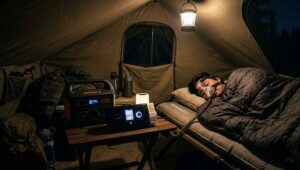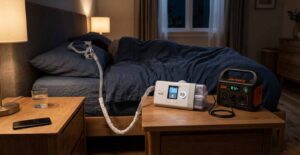

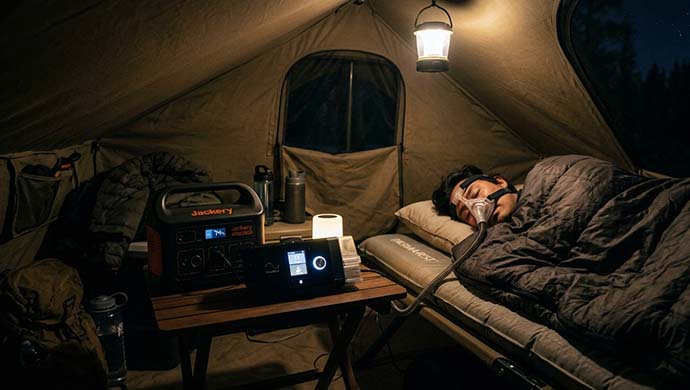
For CPAP users, uninterrupted sleep therapy is essential. Whether you’re preparing for a power outage, planning a camping trip, or traveling off-grid, one question comes up repeatedly:
How long can a portable power station run a CPAP machine?
The answer depends on several variables, including your CPAP machine’s power consumption, battery capacity, humidifier settings, and the efficiency of your power station.
Some users assume a larger battery automatically guarantees multiple nights of use. In reality, runtime calculations are more nuanced. Understanding how battery capacity translates into real-world CPAP usage can help you avoid buying a backup system that falls short when you need it most.
This guide breaks down runtime estimates, battery calculations, and practical tips for extending CPAP usage.
What Determines CPAP Runtime?
Portable power stations do not power CPAP machines for a fixed number of hours. Runtime depends on several factors working together.
The main variables include:
- CPAP machine wattage
- Battery capacity (Wh)
- Humidifier usage
- Heated tube settings
- Power conversion efficiency
- AC versus DC connection type
A machine consuming 35 watts behaves very differently from one consuming 90 watts with heated accessories enabled.
Understanding Battery Capacity (Wh)
Portable power stations are usually rated in watt-hours (Wh).
A watt-hour measures how much energy a battery stores.
Common battery sizes:
Battery Capacity | Typical Category |
200Wh | Compact travel backup |
300Wh | Lightweight overnight use |
500Wh | Multi-night CPAP support |
1000Wh+ | Extended backup and emergency use |
A higher Wh rating generally means longer runtime.
However, actual results depend on energy losses and machine settings.
CPAP Runtime Formula
A simple formula can estimate runtime:
Battery Capacity ÷ CPAP Wattage = Estimated Hours
Example:
Portable power station: 300Wh
CPAP machine usage: 40W
300 ÷ 40 = 7.5 hours
This suggests approximately one night of sleep therapy.
Real-world efficiency losses often reduce usable power by 10–20%.
A more realistic estimate:
300Wh × 0.85 = 255Wh usable energy
255 ÷ 40 = 6.4 hours
Always account for battery conversion losses.
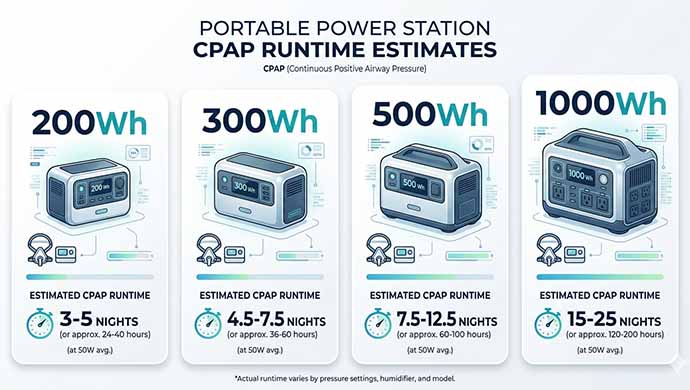
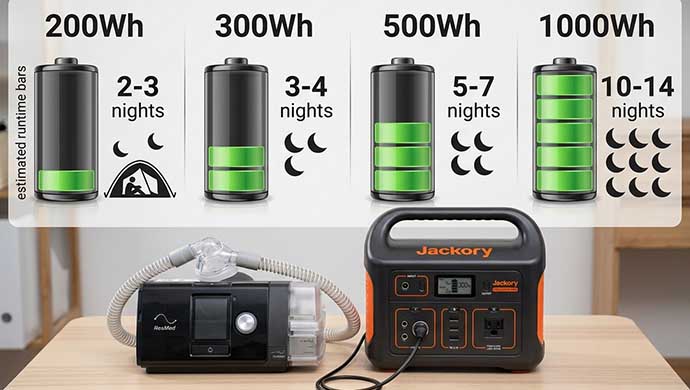
Estimated CPAP Runtime Chart
Below are realistic estimates for average CPAP use.
Assumption:
- CPAP machine without humidifier: 35–45W
- Heated features disabled
Battery Size | Estimated Runtime |
200Wh | 4–6 hours |
300Wh | 6–9 hours |
500Wh | 10–14 hours |
1000Wh | 20–28+ hours |
For users who rely on battery power frequently, choosing the correct size matters.
Many people compare several models before selecting the best portable power station for CPAP for overnight reliability.
Why Heated Humidifiers Reduce Runtime
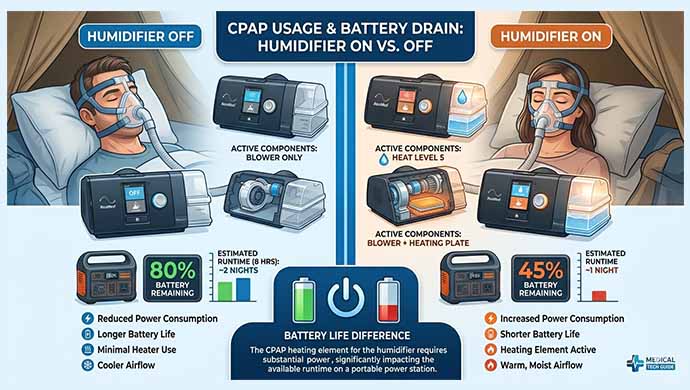
Many users are surprised to discover that heated accessories dramatically increase power consumption.
Typical example:
Without humidifier:
CPAP usage = 40W
With humidifier and heated tube:
CPAP usage = 80–100W+
That can reduce battery runtime by half.
A portable power station that lasts two nights without heat may only last one night with heated settings enabled.
Because of this, travelers often disable heated features when battery life matters.
AC Power vs DC Power: Which Lasts Longer?
Many CPAP machines can run using AC or DC power.
DC connections are usually more efficient because they avoid unnecessary energy conversion.
Benefits of DC operation:
- Reduced energy loss
- Longer battery runtime
- Improved efficiency
- Better performance during travel
Some users gain 10–20% additional runtime simply by using a compatible DC adapter.
How to Extend CPAP Battery Runtime
If you want more overnight usage:
- Turn off heated humidifiers
- Disable heated tubing
- Use DC power when available
- Lower display brightness
- Charge fully before use
- Carry a solar panel for recharging
Small adjustments can significantly increase total runtime.
Choosing the Right Portable Power Station Size
Different users have different requirements.
General recommendations:
Travel and occasional use:
200–300Wh
Weekend camping:
300–500Wh
Frequent power outages:
500–1000Wh
Multiple nights or heated accessories:
1000Wh+
If runtime is a priority, many users start by researching the best portable power station for CPAP before deciding on battery size.
Frequently Asked Questions
Can a 300Wh power station run a CPAP overnight?
Yes. Many CPAP machines without heated accessories can operate for a full night on a 300Wh battery.
Does a humidifier reduce battery life?
Yes. Heated humidifiers can significantly increase power consumption.
Is a larger power station always better?
Not necessarily. Larger batteries increase weight and cost. The ideal choice depends on your runtime needs.
Can solar panels recharge a CPAP power station?
Yes. Many portable power stations support solar charging for extended off-grid use.
Final Thoughts
Portable power station runtime for CPAP machines depends on battery capacity, machine settings, and overall efficiency.
For many users, a 300–500Wh battery provides enough power for overnight use, while larger systems support multiple nights and additional devices.
Understanding your energy requirements before buying can prevent unexpected interruptions during sleep therapy.
If you’re still comparing battery sizes and features, exploring the best portable power station for CPAP can help you find the right balance between portability, runtime, and reliability.