

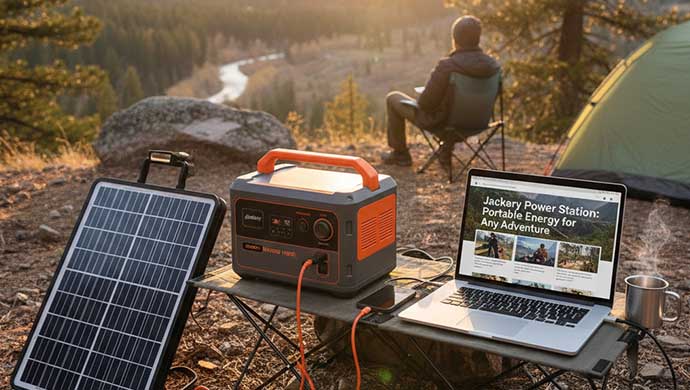
A Jackery power station is a portable battery-powered unit that stores electricity and provides power for various devices and appliances. Whether you are camping, facing a power outage, or need a portable energy source for outdoor activities, Jackery offers reliable solutions.
In this guide, you will learn everything about Jackery power stations: what they are, how they work, their lifespan, advantages, disadvantages, and how they compare to solar generators. This guide also links to more detailed articles for each topic.
Features of a Jackery Power Station
Jackery power stations are designed to be portable, reliable, and versatile. Here are some key features:
- Multiple Output Ports: AC outlets, USB-A, USB-C, and 12V carports.
- Portable Design: Compact and lightweight, easy to carry.
- Rechargeable: Can be recharged via wall outlet, car, or solar panels.
- LCD Display: Shows battery level, input/output wattage.
- Safe Operation: Built-in protections for overcharge, overcurrent, and short circuits.
Popular Jackery Models:
- Explorer 240: Small, portable, ideal for charging phones, laptops, or small devices.
- Explorer 500: Medium capacity, suitable for mini-fridges, fans, or multiple devices.
- Explorer 1000: High-capacity model for longer trips or larger devices.
- Explorer 2000 Pro: Large power station capable of powering many household appliances.
How Does a Jackery Power Station Work?
A Jackery power station is not a generator by itself. It stores electricity in a lithium-ion battery and delivers power through AC and DC outlets.
Components:
- Battery: Stores the electricity.
- Inverter: Converts DC battery power to AC power for household devices.
- Charge Controller: Manages solar panel input if you connect solar panels.
- Output Ports: AC, DC, and USB outputs deliver energy to devices.
Charging Options:
- Wall Outlet: Fastest and most common.
- Carport: Charges while driving.
- Solar Panels: Eco-friendly, can recharge using sunlight.
For a detailed explanation of the internal mechanism, see How does a Jackery power station work?
Battery Life and Lifespan
The lifespan of a Jackery power station depends on battery cycles. Most lithium-ion batteries have 500–1000 cycles before noticeable capacity loss.
Typical Usage:
- Explorer 1000: Can run a fridge for 10–12 hours, charge a laptop 20–25 times.
- Explorer 2000 Pro: Can power multiple appliances for hours during a blackout.
Learn more in How long will a Jackery power station last?
Maintenance Tips:
- Avoid complete discharge frequently.
- Keep the battery between 20–80% for longevity.
- Store in a cool, dry place.
Uses of a Jackery Power Station
Jackery power stations are highly versatile and can be used in:
- Camping & Outdoor Adventures: Power lights, speakers, fans, or mini-fridges.
- Emergency Backup: Charge phones, medical devices, laptops during blackouts.
- Home Appliances: Run essential devices like fridges, fans, laptops, or LED lights.
- Work from Anywhere: Charge electronics without needing wall outlets.
Wondering if it can power your entire house? See Can a Jackery power a house?
Jackery vs Solar Generator
A Jackery power station can be paired with solar panels to become a solar generator, but by itself, it is just a battery.
Feature | Jackery Power Station | Solar Generator |
Power Source | Battery, wall, car, optional solar | Battery + Solar panels |
Includes Solar Panels | ❌ No (sold separately) | ✅ Usually included |
Eco-Friendliness | Partial (if solar added) | Fully eco-friendly |
Usage | Portable power, camping, backup | Off-grid living, long-term outdoor use |
Price | Affordable (without solar) | Higher |
For full comparison, see What is the difference between Jackery power station and solar generator?
Pros & Cons of Jackery Power Stations
Pros:
- Portable & lightweight
- Multiple charging options
- Safe & quiet operation
- Reliable for essential devices
- Expandable with solar panels
Cons:
- Limited capacity for full-house use
- Can be expensive per watt
- Long charging time for large models
- Battery degrades over years
Read detailed limitations in What are the disadvantages of a portable power station?
Frequently Asked Questions (FAQ)
Can a Jackery power station run a fridge?
Yes, larger models like Explorer 1000 or 2000 Pro can power a fridge for 10–20 hours.Can I charge Jackery using solar panels?
Yes. Jackery SolarSaga panels can recharge the battery using sunlight.Can Jackery power a house?
It can power essential appliances, but not an entire home with AC, water heater, and oven.What is the difference between Jackery and a solar generator?
A Jackery alone is a battery. A solar generator includes solar panels + battery system.How long will the battery last?
Depends on cycles. Proper maintenance can extend battery life to several years.
Conclusion
A Jackery power station is a versatile, portable, and reliable energy solution. It can power electronics, small appliances, and emergency devices, and can be upgraded with solar panels for eco-friendly use.
For a complete understanding of Jackery’s functionality, battery lifespan, comparisons, and limitations, check the detailed cluster articles:
- How does a Jackery power station work?
- How long will a Jackery power station last?
- What is the difference between Jackery power station and solar generator?
- Can a Jackery power a house?
- What are the disadvantages of a portable power station?